
Pay by Bank
Accept payments directly from your customers' bank accounts using Open Banking.
Pay by Bank
Accept payments directly from your customers' bank accounts using Open Banking.
Pay by Bank allows your customers to make payments directly from their bank account using Open Banking technology. It supports two payment types:
- Single Immediate Payments (SIP): a single, immediate bank transfer initiated by the customer at the point of checkout.
- Variable Recurring Payments (VRPs): a series of payments made against a pre-authorised mandate, without requiring the customer to re-authenticate for each transaction.
Both payment types are processed in real time over Faster Payments and do not involve card networks, reducing costs and eliminating card chargeback risk.
Note: Pay by Bank is only supported when using GBP as the currency.
One-off payments
A one-off Pay by Bank payment is a Single Immediate Payment (SIP), a real-time bank transfer where the customer authorises a specific amount in a single interaction.
How it works
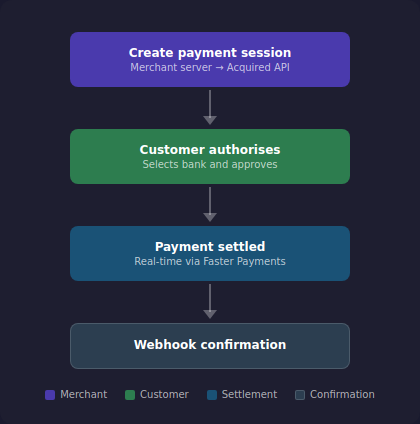
- Create a payment session. Your server creates a payment request via the Acquired API, specifying the amount, currency, and a redirect URL for the customer to return to after authorisation.
- Redirect the customer. The customer is directed to their bank, either via the Acquired Hosted Checkout or your own UI built using the API. They select their bank, authenticate, and approve the payment.
- Receive confirmation. Once the customer approves the payment, funds are transferred immediately over Faster Payments. You receive a webhook notification confirming the outcome, and the customer is redirected back to your site.
One-off payments are best suited for e-commerce checkouts, ad-hoc payments from a client portal, and any scenario where a customer is making a single transaction.
Integration options: One-off Pay by Bank payments can be accepted through Hosted Checkout or via the API with a custom UI. Support for Pay by Bank via Components is coming soon, get in touch if you're interested.
Recurring payments
Recurring Pay by Bank payments use Variable Recurring Payments (VRP), an Open Banking capability that allows you to collect multiple payments from a customer under a single, pre-authorised mandate.
VRP types
The type of VRP you use will influence which banks are available to your customers.
| Type | Description | Bank availability |
|---|---|---|
| Sweeping | Move funds between two accounts belonging to the same customer (e.g. current account to savings pot). | Broadly available |
| Commercial | Collect payments from a customer to a third party (e.g. utilities billing). Acquired supports the UK Payments Initiative (UKPI) to provide cVRPs. | Varies by bank participation in UKPI |
If you are unsure which VRP type applies to your use case, contact us and we can advise.
How it works
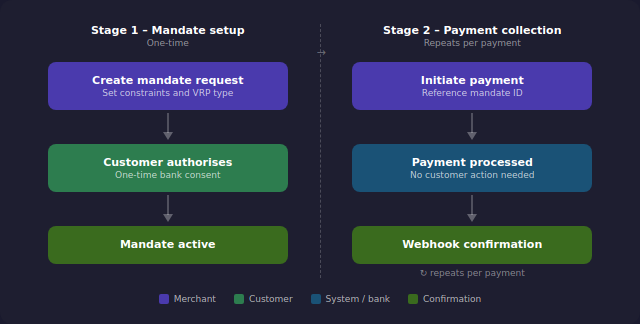
Recurring payments follow a two-stage process: mandate setup, then payment collection.
Stage 1: Mandate setup
- Create a mandate request. Your server creates a mandate via the Acquired API, defining the constraints that govern future payments.
- Customer authorisation. The customer is redirected to their bank, where they review the constraints and provide consent. This is a one-time step.
- Mandate activated. Once authorised, the mandate is active and ready to use. You receive a webhook confirming the mandate status.
Mandate constraints (consent parameters)
The following parameters are set when creating a mandate. For Commercial VRP, these are the consent parameters the customer approves at their bank:
| Parameter | Description |
|---|---|
max_amount_per_payment | Maximum amount that can be charged in a single transaction. |
periodic_limit | Cap on the total amount or number of payments within a given period (e.g. per month). |
start_date / end_date | Optional validity window for the mandate. |
Note: Customers can view and cancel their mandate directly from their banking app at any time. Your integration must also support a merchant-initiated mandate cancellation flow.
Stage 2: Payment collection
Once a mandate is in place, you can collect payments without any further customer interaction, as long as each payment falls within the agreed constraints.
- Initiate a payment. Your server creates a payment request referencing the active mandate ID, specifying the amount for that transaction.
- Payment processed. The payment is executed immediately over Faster Payments. No customer redirect is required.
- Receive confirmation. A webhook notifies you of the payment outcome.
Note: If a requested payment exceeds the mandate constraints, it will be declined. Ensure your payment amounts are validated against the mandate before submission.
Recurring Pay by Bank payments are well suited for subscription billing, savings contributions, top-ups, and any use case requiring flexible, variable-amount collections.
Choosing the right payment type
| One-off payment | Recurring payment | |
|---|---|---|
| Customer authentication | Required for each payment | Required once (mandate setup only) |
| Amount | Fixed per transaction | Variable, within mandate constraints |
| Settlement | Real-time (Faster Payments) | Real-time (Faster Payments) |
| Best for | E-commerce checkouts, ad-hoc invoices, one-time payments | Subscriptions, top-ups, savings contributions |
Customer authentication
The authentication experience depends on the customer's device:
| Device | Experience |
|---|---|
| Mobile | The customer is redirected directly to their mobile banking app to authenticate and approve. Once complete, they are returned to your redirect URL. |
| Desktop | A QR code is displayed, allowing the customer to hand off authentication to their mobile device. Their banking app launches automatically on the mobile device. Once approved, the customer is directed back to your site on desktop. |
This applies to both one-off payment authorisation and mandate setup for recurring payments. The authentication step only occurs once for VRP mandates. Subsequent payments collected against the mandate require no customer interaction.
Closed-loop Open Banking settlement
Your Pay by Bank funds will be settled into an Acquired ledger. With closed-loop settlement, payments collected via Pay by Bank settle directly into your Acquired settlement account.
This means:
- Faster reconciliation. Payments move from
executedtosettledwithin the Acquired platform, giving you a single source of truth for transaction status. - Reduced operational overhead. There is no need to match incoming bank transfers against payment records across separate systems.
- Instant refund and payout capabilities. With funds held in your Acquired ledger, you can issue refunds and payouts instantly without waiting for external bank processing.
Funds held in your Acquired-managed account are batch settled to your external bank account each working day.
Updated 19 days ago